
This blog explains how Instagram’s engagement rate works and why it’s more important than ever in 2026. It shares advice on how to create content that drives genuine interaction, with industry benchmarks to help you measure your performance and refine your Instagram marketing strategy.
Instagram is no longer just a photo-sharing app. It’s a strategic marketing platform where strategic content drives measurable ROI. As noted in 2024, 79% of global marketers leveraged Instagram for the efficient marketing of various products and services.
As reported in 2026 by Statista, Instagram reels have about two billion active users. Furthermore, the time users spend on Instagram accounts is reported to be around 17.6 million hours of daily watch time.
However, in today’s saturated digital ecosystem, it’s not just the impressions or views that matter; it’s the engagement. For content strategists, brand managers, and social media analysts alike, the average Instagram engagement rate serves as a critical parameter, reflecting not just reach but real audience resonance.
This aspect answers the most critical social media marketing question: Does your audience interact with your content? Read this insightful article to understand, optimize, and benchmark Instagram engagement.
To boost visibility and engagement, Instagram SEO focuses on optimizing captions, hashtags, and profiles—helping your content reach the right audience and maximize ROI in today’s competitive social media landscape.
What Is Instagram Engagement Rate?
Instagram engagement rate is the percentage of followers or viewers interacting with your content. This includes likes, comments, shares, saves, replies, and video views.
However, in 2026, the Instagram engagement landscape has evolved. The latest algorithm changes prioritize quality interaction over volume. It implies that vanity metrics, such as likes, are less impactful than shares, saves, and comments.
There are two primary formulas to calculate Instagram engagement rate:
- By follower countTo know the engagement rate, divide the sum of interactions (likes, saves, shares, and comments) on your post by the follower count you had at the time of posting it. Here’s the formula:Instagram engagement rate considering the follower count = (Engagements / Total Followers) × 100
- By reach or impressionsCalculating the engagement rate on reach is a more accurate way of assessing this crucial parameter. It is calculated by dividing the sum of interactions (likes, saves, shares, and comments) on your post by the total reach when it is posted. Here’s the formula:Engagement rate considering the total reach/impressions = (Total Engagements / Total Reach) x 100
Please note: Instagram now separates Reels metrics and Story metrics more explicitly in its analytics suite (as of Q1 2026), which means businesses must segment their performance tracking accordingly.
To better understand your ROI, it’s important to analyze engagement alongside the Instagram Advertise Cost, ensuring your campaigns drive both quality interactions and cost-effective visibility on the platform.
Why Instagram Engagement Rate Matters
In the rapidly evolving social media landscape, measuring and assessing engagement is no longer optional. Learning about the engagement rate is crucial to determining content efficiency, platform relevance, and campaign ROI. Below are the key reasons why Instagram engagement rate matters.
- It reflects a true audience connection
Consider an Instagram account with about 10,000 followers with an engagement rate of 0.1%. This is a low engagement rate, implying that the account is not able to connect well with the audience. - It drives algorithmic visibility
Instagram’s 2026 algorithm prioritizes comments, saves, and shares over likes. It implies that Instagram posts with better engagement are pushed to more users, boosting organic reach exponentially. - It affects paid campaign efficiency
Posts with more engagement cost less to promote. Instagram ads with high post engagement benefit from reduced CPMs and higher CTRs, making engagement a cost optimization lever in your paid media strategy. - It provides cross-platform insights
High-performing Instagram stories, reels, and carousels often serve as templates for content replication on other social media platforms, including Facebook, TikTok, and LinkedIn.
Instagram engagement rate plays a vital role in social media management by influencing algorithm visibility, ad performance, and helping brands build meaningful connections with their audience across platforms.
Factors That Influence Instagram Engagement Rate
Learning about the factors influencing Instagram engagement rate is crucial for crafting compelling social media content. Here are some of the key factors that are based on the latest 2026 trends.
Content Types That Drive Engagement
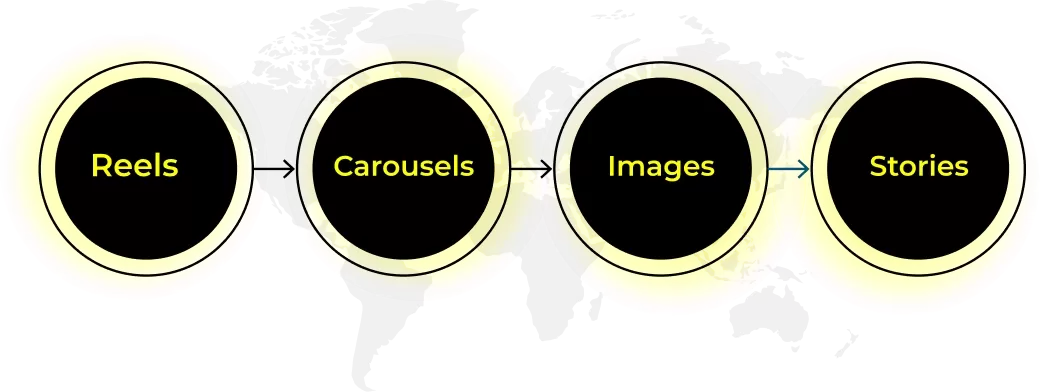
The following are the different types of content that trigger different types of engagement.
- Reels
As reported lately, Instagram reels generate a higher engagement rate of 1.23%, better than other content formats popular on LinkedIn. Furthermore, Instagram reels reportedly reach about 726.8 million users, comprising 55.1% of the platform’s ad audience, and dominate 35% of screen time. - CarouselsReels dominate reach, but carousels drive better engagement. As reported, carousels drive 12% more engagement compared to reels and about two times more than single-image posts.Also, carousel posts have higher engagement rates than photo posts and traditional video posts. As per a 2026 performance audit, 49% of Gen Z prefer carousel posts over static images when browsing on Instagram.
- Images
Static images are still popular, implying the need to diversify content types to attain marketing goals. Static image posts reportedly maintain an average engagement rate of around 0.70%, which varies by industry. - StoriesInstagram stories are essential for maintaining ongoing audience engagement. Gen Z users, in particular, prefer story-based content over typical feeds.As highlighted in a recent report, roughly 53.7% of ad revenue on Instagram is driven by in-feed ad formats, and stories currently generate 24.6% of Instagram’s ad revenue.
Believing that only influencers boost engagement is an influencer marketing myth—content types like reels, carousels, and stories play a bigger role in improving Instagram engagement rates in 2026.”
Posting Frequency and Timing
Posting frequency:
Posting frequency continues to play a pivotal role in driving engagement in 2026. Brands that consistently publish 3 to 5 feed posts per week tend to see stronger audience interaction compared to those posting less frequently, as revealed by recent analysis of Instagram activity trends.
Best time to post:
As a general assessment, the best time to post on social media is around 8 am on Wednesdays. However, what works best differs for every social media platform.
For Instagram, the universal best time to post, based on an analysis of data from more than 1 million social posts, is as follows:
- Mondays, 3 pm to 9 pm
- Tuesdays, 5 am to 8 am and 3 pm to 7 pm
- Thursdays, 5 pm to 7 pm
Use AI tools for social media to optimize posting frequency and timing, helping brands schedule Instagram posts efficiently and boost engagement by analyzing the best times to post content.
Audience Demographics and Behavior
The target audience’s age, location, and behavioral patterns significantly impact engagement trends on Instagram.
- As per a recent report by Statista, nearly 32% of Instagram’s global user base in 2026 falls within the 25–34 age bracket, making it the platform’s most active demographic.
- Gen Z users (aged between 18 and 24) accounted for 29.5%, and older age groups (aged between 35 and 44) accounted for 16.3%, as per the same report.
- Upgrow reports that some local business posts with geotags saw up to 79% more engagement, demonstrating the importance of using regional hashtags to engage the target audience.
Instagram Algorithm Impact
Instagram’s 2026 algorithm update has a considerable impact on the content strategy. Here are the significant changes and their impact:
- The algorithm now prioritizes deeper engagement, implying that saves and shares are favored over likes.
- The algorithm often amplifies content that receives strong engagement soon after it is posted (within the first hour of posting).
- The algorithm favors long-form comments (4+ words), as more thoughtful responses showcase authentic engagement.
- Instagram posts with clear CTAs, such as “Save this for later” or “Share with your team,” can drive up to 31% more clicks and engagement.
Stay ahead of the evolving social media algorithm by understanding how Instagram’s 2026 update influences engagement, prioritizing saves, shares, and long-form comments for better post visibility and reach.
Average Engagement Rate on Instagram: Industry Benchmarks
Benchmarking Instagram engagement rate against industry standards is crucial for performance evaluation. This section details the latest 2026 statistics, covering overall averages, industry-specific benchmarks, and influencer tier data.
Overall Average Engagement Rate
Instagram’s median engagement rate saw a sharp dip, falling from 2.94% in January 2024 to just 0.61% by January 2026, as reported by a credible source. This considerable drop is attributed to the following key factors:
- A rapid increase in the content volume
- Saturation of ads and brand posts
- Engagement with posts is becoming more private
- Algorithmic changes are prioritizing authentic engagement (comments and saves over likes)
Breakdown by format:
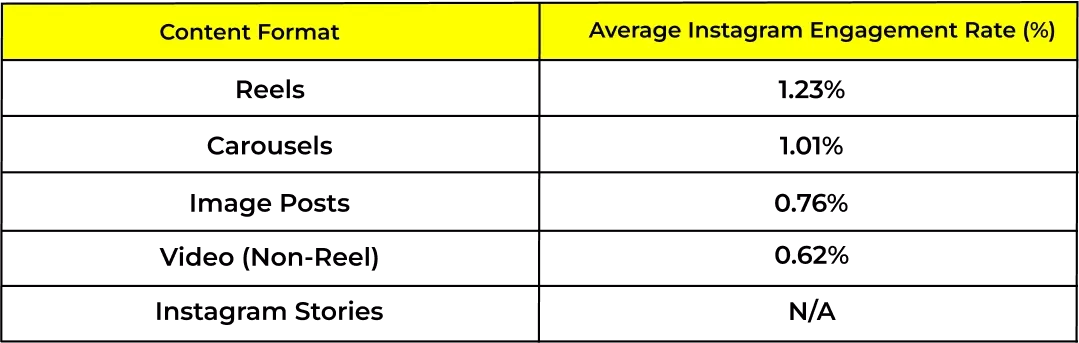
Please note: Instagram Stories engagement is measured via taps, replies, and sticker interactions. It is not directly factored into platform averages.
A good Instagram engagement rate is between 1% and 5%. Anything below 1% indicates low resonance and weak interaction.
To improve low engagement rates, it’s essential to align your content strategy with the best times to post on social media and boost visibility during peak interaction hours.
Engagement Rates by Industry
Here are the average Instagram engagement rates for various industries as reported in January 2026.
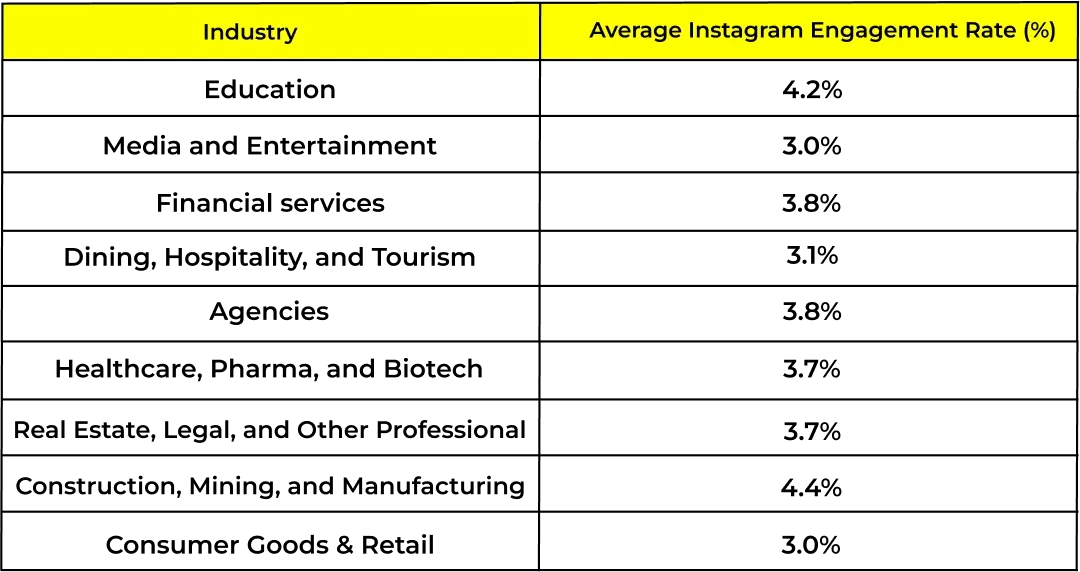
Key takeaways:
- Construction and Manufacturing top the list with a 4.4% engagement rate, proving even traditional sectors can thrive on Instagram with the right content strategy.
- Education also sees a high engagement at 4.2%, likely due to strong community involvement and visual storytelling.
- Financial services and Agencies, both at 3.8%, stand out among professional sectors, suggesting that informative, trust-driven content performs well.
- By contrast, Retail and Media, despite their visual edge, average around 3.0%, indicating content fatigue or oversaturation of these categories.
Engagement Rate by Influencer Tier
Influencer marketing is still a powerful lever for engagement on Instagram. Here are Instagram influencer engagement rates worldwide by follower count as reported by Statista.
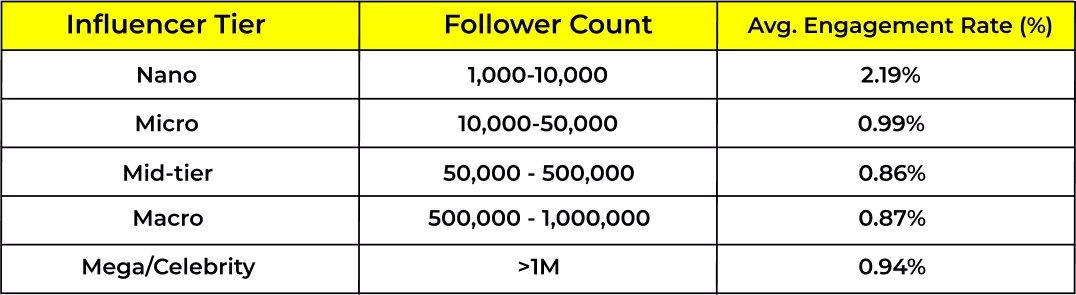
Key takeaways:
- Nano influencers bring authentic, niche audience interaction, which translates into higher engagement.
- For brands and B2B campaigns, collaborating with micro/nano influencers through an influencer marketing platform yields more actionable outcomes compared to larger influencers with diluted audiences.
Tips to Improve Your Instagram Engagement Rate
Now that we have unraveled the various critical aspects of Instagram engagement and what a good engagement rate looks like, let’s focus on how to improve it. Whether you are a brand, agency, or creator, boosting Instagram engagement is a continuous and evolving task.
This section entails four high-impact strategies rooted in platform changes, behavioral data, and 2026 best practices. All tips are applicable across diverse verticals, including B2C, B2B, D2C, and influencer-led content.
Create Interactive and Engaging Content
Engagement starts with the content itself. In 2026, Instagram will favor formats and posts that encourage people to go beyond likes and react, save, or share, demonstrating deeper engagement.
- Polls, quizzes, and emoji sliders in Instagram stories are no longer a novelty. They are essential engagement boosters, especially among Gen Z audiences. According to the latest Gen Z marketing statistics for 2026, 57% of Gen Z prefer engaging with infographics or short visual summaries over essays and articles.
- Carousel posts lead to more engagement than static posts. In line with the latest data, 49% of the Gen Z audience prefer carousel posts over static images.
- Use CTAs like “Save this for later,” “Tag someone who needs this,” or “What do you think?” to elicit meaningful replies. Comments with more words now weigh heavier in the algorithm, as they signify genuine interaction.
Pro tip: Don’t just inform; invite active participation. Users are more likely to be involved with content that seeks their opinion or solves a micro problem.
Optimize Posting Schedule
Posting frequency and timing significantly impact how a post performs and how audiences interact with the content.
Frequency
- Social media experts recommend posting 3 to 5 posts and 4 to 7 stories per week for optimal engagement. However, the frequency of posting can vary depending on specific goals and the target audience.
- A recent analysis of over 100,000 users shows that individuals who posted regularly on Instagram witnessed five times more engagement than those who posted occasionally.
Timing
- The best time to post on Instagram is reportedly Monday, 3 pm to 9 pm; Tuesday, 5 am to 8 am and 3 pm to 7 pm; and Thursday, 5 pm to 7 pm.
- Also, there’s no rule for posting; it is better to avoid posting early in the morning, viz., 6 am to 8 am, and late at night, viz., 10 pm to 6 am, as the engagement tends to dip below 1%.
Pro tip: It has been observed that reels perform better during lunch hours, viz., 11 am to 1 pm, and stories perform during commutes, viz., 7 am to 9 am and 6 pm to 8 pm. You may test and track the time slot using credible tools.
Engage Directly With Your Audience
Instagram is not a one-way broadcast channel. Direct interaction, including micro-interactions, leads to higher engagement and better brand awareness. Here are a few handy tips to engage directly with your audience.
- Try replying to every comment within the first hour of posting. This not only boosts the engagement rate but also indicates activity to the algorithm.
- Use pinned comments strategically. Highlight audience contributions or FAQs to spark a conversation.
- Acknowledge DMs. Instagram’s latest feature allows brand responses to show as ‘seen,’ which can significantly boost the response rate.
- Conduct ‘Ask Me Anything’ sessions or ‘You said, we created’ reels to convert passive followers into active fans.
Use Hashtags and Collaborations Effectively
Even in 2026, Instagram hashtags play a strategic role in content discovery and connecting with the right audience.
- Use a blend of branded, community-based, and niche hashtags. The optimal range is 5 to 9 hashtags per post, with higher engagement reported with the use of fewer and relevant hashtags.
- Branded hashtag campaigns leveraging user-generated content (UGC) experience a 28% higher engagement than those that don’t. Consumers reportedly find UGC 9.8 times more impactful than influencer content while making purchase decisions.
- It is prudent to collaborate with Nano and Micro influencers. According to the latest Statista report, Nano and Micro influencers contributed to engagement rates of 2.19% and 0.99%, respectively, which is better than those of Macro and Mid-tier influencers.
Pro tip: Combine hashtags with Instagram Collab posts, a format that allows two profiles to co-author a single post. This can double your reach and improve engagement rate per follower.
Want better engagement on Instagram? Learn the best Hashtags Uses in 2026 to increase visibility, reach niche audiences, and improve campaign performance through UGC and influencer collaborations.
Tools to Track and Analyze Engagement Rate
Instagram Insights
Instagram Insights remains the default analytics tool for creators and business profiles that helps them manage content directly from the platform.
What it offers:
- Tracks engagement actions, including likes, comments, shares, saves, and video views across all formats, including posts, reels, stories, etc.
- Provides demographic breakdowns (age, gender, and location) and audience activity windows, helping identify optimal posting times
- Offers metrics on reach and impressions, now reconstructed around Meta’s evolving focus on content views as the key visibility metric.
- While Instagram doesn’t natively display engagement rate, marketers can calculate it using: Engagement Rate = (Likes + Comments + Saves) ÷ Reach × 100
As of 2026 Q1, Instagram’s average engagement rate across all content types is about 0.50%. With built-in tracking, real-time metrics, and no additional cost, Instagram Insights is essential for baseline measurement and early-stage performance audits.
Social Insider
Social Insider is a comprehensive analytics and competitive intelligence platform that is trusted by brands and agencies seeking data-driven growth strategies.
What it offers:
- Tracks all relevant metrics, including likes, comments, shares, saves, reach, impressions, etc.
- Enables competitor benchmarking and hashtag monitoring
- Offers AI-based content clustering, sentiment analysis, and custom reports
- Built for multi-account teams with custom dashboards and collaboration tools
Social Insider is an excellent platform that delivers a comprehensive view of content effectiveness. It allows brands to benchmark against competitors, identify impactful formats and hashtags, and track shifts in audience sentiment, presented through visual dashboards optimized for executive or client reporting.
Sprout Social
Sprout Social positions itself as an all-in-one engagement, publishing, and analytics platform, trusted by marketing teams and SMBs.
What it offers:
- Comparative engagement metrics across networks with deep insights into Instagram’s performance vs. Facebook, LinkedIn, and more
- Quarterly content benchmarks, derived from analyzing billions of messages across industries
- Features for community engagement, listening, and competitive intelligence
- Easy-to-use visualization tools to share data with stakeholders and executives
As per the 2026 Content Benchmarks report, available on Sprout Social, Instagram engagement rose by 28%. Sprout Social helps translate engagement numbers into meaningful insights to facilitate strategizing and decision-making.
Hootsuite Analytics
Hootsuite offers a unified analytics dashboard across multiple social media platforms, making it a favorite among agencies and enterprise-grade teams.
What it offers:
- Platform-wide engagement metrics for Instagram and other social media platforms
- Industry-specific benchmarking, allowing real-time comparison of performance metrics to sector averages
- Capability to calculate engagement rate using likes, comments, shares, and follower counts
- Scheduling, sentiment tracking, and reporting tools are available within the same ecosystem
Hootsuite stands out by enabling cross-channel analysis and sector-level benchmarks. Reporting, scheduling, and sentiment analysis are all centralized, ensuring analytical efficiency and strategic clarity.
Conclusion
The Instagram engagement rate in 2026 remains one of the most critical KPIs for brands and marketers navigating today’s algorithm-driven social media landscape.
Whether you are analyzing your own Instagram account, planning an influencer marketing campaign, or designing social media posts for brand storytelling, understanding how to measure engagement, benchmark against peers, and contextualize your performance can help boost engagement and optimize ROI.
From content formats to audience behavior, and from post timing to influencer tiers, every element contributes to your brand’s average engagement rate on Instagram. While more followers may expand reach, engagement rate is the metric that shows whether those followers truly care.
Whether you are using free tools like Instagram Insights or investing in premium analytics platforms, tracking the engagement over time will give you the data clarity required to refine your content strategy, grow your brand presence, and stay competitive in today’s social-first world.
FAQs
What is a good engagement rate on Instagram?
A good engagement rate on Instagram in 2025 is anything between 1% and 5%. Anything between 3% and 5% is considered excellent, while a rate above 5% is considered outstanding. Nano and Micro influencer accounts often perform better, while big brand pages may see lower but impactful averages.
How is the Instagram engagement rate calculated?
Instagram’s engagement rate can be calculated using two standard formulas, one based on total followers and the other on post reach.
Instagram engagement rate considering the follower count = (Engagements / Total Followers) × 100.
Instagram engagement rate based on post reach = (Engagements / Impressions or Reach) × 100.
Do Instagram Reels have a higher engagement rate?
Yes, Instagram Reels typically have a higher engagement rate compared to standard posts and static images. As per the latest report, reels average about 0.50% engagement, compared to images at 0.45%. Reels are the best choice for fetching more impressions for small to medium-sized accounts with less than 50K followers.
Is a higher follower count always better for engagement?
No, a higher follower count doesn’t always imply better engagement. Smaller accounts (Under 10K) often see higher engagement rates, typically between 2% and 6%, or even higher due to strong audience connection.
On the other hand, larger profiles may reach a larger audience, but usually average 1 to 2% engagement, making audience quality more important than size for engagement.
How often should I post to maintain a good engagement rate?
To maintain a good engagement rate on Instagram in 2025, try to post at least 3 to 5 times a week, balancing quality with consistency. Too few posts limit reach, while too many may overwhelm your followers. The ideal frequency varies by industry. However, regular and insightful content keeps the target audience engaged without causing fatigue.