
In 2026, people spend over 2 hours daily on social media, with teens logging the most time. Usage varies by age and region, raising concerns about mental health and digital wellness.
Social media has become a foundational element of daily life, deeply integrated into how people communicate, consume information, and entertain themselves. In 2026, it’s no longer surprising to hear that the average user spends over two hours daily engaging with platforms like TikTok, Instagram, Facebook, and YouTube. However, what changed was the purpose and intensity of that time.
Social media touches nearly every aspect of modern interaction, whether for maintaining long-distance relationships, promoting businesses, following trends, or simply relaxing. The platforms we use, how long we use them, and the motivations behind that use vary greatly depending on age, region, lifestyle, and even occupation.
If we understand the way time on social media is distributed, we get important insights into societal behavior and can help inform healthier habits, tech policies, and media literacy education.

How Much Time Do People Spend on Social Media Per Day?
In early 2026, research from DataReportal and Global WebIndex confirms that the global average daily time spent on social media stands at approximately 2 hours and 21 minutes, or 141 minutes per day. That marks a subtle decrease from 143 minutes in 2024, signaling a modest dip but underlining that social media remains a deeply ingrained part of daily life. Meanwhile, Hootsuite and Talkwalker data affirm a roughly similar figure, at 2 hours 24 minutes per day.
What’s fascinating is that despite the addition of new platforms like Threads and Bluesky, average screen time hasn’t spiked. Instead, users spread their attention across more platforms, nearly seven monthly on average, but overall time moves slightly upward. This suggests users are fragmenting their digital attention rather than dramatically increasing screen time.
Such Social Media Statistics show that growth in the number of platforms doesn’t always lead to longer usage times. Instead, these Social Media Statistics reveal a redistribution of attention across multiple apps.
Which Social Media Platform Do People Spend the Most Time on?
The dominance of short-form, video-driven platforms remains unchallenged. Aggregate North American and global data reveal TikTok leads with about 54 to 59 minutes per day, closely followed by YouTube at 49 to 60 minutes daily. TikTok’s average session length is reported to be around six minutes, making it one of the most addictive formats out there.
Behind these trailblazers are major global trends: Facebook users average around 31 to 32 minutes per day, Instagram about the same, and platforms like X (Twitter) and Snapchat come in at around 30–34 minutes daily. On messaging apps, WhatsApp users spend an estimated 34 minutes daily, suggesting that messaging, though not traditionally viewed as social media, forms a significant part of online engagement.
In essence, the platforms commanding the most time are those built around dynamic, visual content and messaging. These are the areas where users can consume, connect, and be entertained without delay.
Recent Facebook Engagement Rate figures indicate that while time spent may be lower than video-first apps, interaction levels remain strong within niche communities. Likewise, WhatsApp Statistics emphasize the platform’s role as a daily communication hub, with consistent usage across diverse age groups.
Average Time Spent by Region/Country
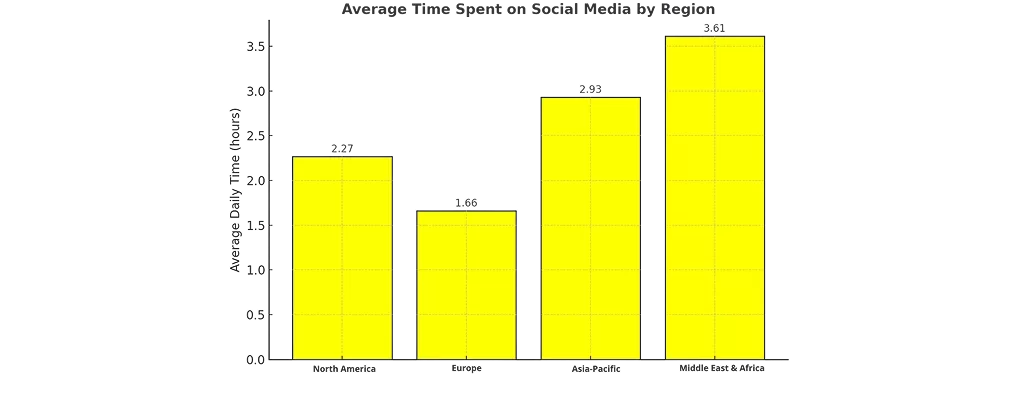
Geographical location significantly influences how people engage with social media. Factors such as internet infrastructure, smartphone penetration, cultural norms, and time availability all affect usage patterns. While some countries are characterized by high daily engagement, others reflect more balanced or limited use due to a lack of access or societal preferences.
North America
North America aligns closely with the global average: around 2 hours and 16 minutes daily. However, this figure masks generational variations; millennials and Gen Z typically exceed it, while older adults fall below it.
Europe
Europe fluctuates but generally mirrors this trend, with countries like the UK and Germany averaging 1 hour 46 minutes to 1 hour 33 minutes daily. These figures may be slightly conservative due to stricter digital regulations and social media skepticism in certain regions.
Asia-Pacific
This region leads global engagement. For example, the Philippines averages an astonishing 4 hours and 14 minutes per day, which is, by far, the world’s highest. Indian users spend an average of 2 hours and 29 minutes daily, while China, despite heavy regulation, maintains around 2 hours and 4 minutes.
Middle East & Africa
Although social media penetration in the Middle East & Africa remains relatively low (around 64% globally), active users in countries like Nigeria, South Africa, and Kenya spend an average of 3–3.5 hours daily. Nigeria clocks in at 3 hours 44 minutes, and South Africa and Kenya around 3 hours 32–34 minutes, reflecting vibrant local communities bound by messaging and video platforms.
Latin America
Latin America is one of the most active regions in the world when it comes to social media usage. On average, internet users spend more than 3 hours and 20 minutes each day on social networking and messaging platforms, well above the global average. Brazil records some of the highest engagement levels, with users spending around 3 hours and 32 minutes daily on social media. Colombia follows closely at approximately 3 hours and 22 minutes per day. In Argentina, the average ranges from 3 hours and 8 minutes to 3 hours and 20 minutes, while users in Mexico spend roughly 3 hours and 20 minutes to 3 hours and 30 minutes daily. Messaging apps such as WhatsApp continue to dominate across the region, alongside platforms like Instagram, Facebook, and YouTube. High smartphone adoption, a young online population, and strong social connectivity contribute to Latin America’s consistently high engagement with social media.
Average Time Spent by Age Group
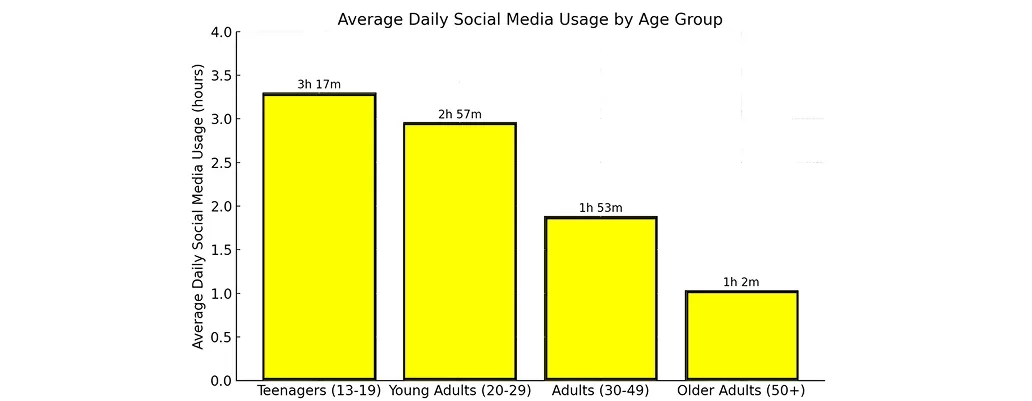
One of the clearest differentiators in social media use is age. From teenagers hooked on TikTok to older adults scrolling Facebook occasionally, each age bracket exhibits distinct usage patterns, platform preferences, and online behaviors. Understanding these differences is critical for marketers, educators, and mental health professionals.
Teenagers (13–19)
Teenagers represent the heaviest users of social media. Global studies cite Gen Z averages at 3 hours 18 minutes daily, U.S. teens stand at a staggering 4 hours 48 minutes, and teenage girls average 5 hours 18 minutes per day. This reflects immersive engagement with multi-platform content, especially short-form videos.
Young Adults (20–29)
For young adults, global usage averages around 3 hours 8 minutes per day for those aged 18–24 and about 2 hours 47 minutes for 25–34-year-olds. Gender differences persist: women in this cohort usually spend a quarter of an hour more daily than men.
Adults (30–49)
Usage falls flat in core adult years, with 35–44-year-olds spending about 2 hours 12 minutes and 45–54-year-olds spending around 1 hour 34 minutes daily. Even as adoption remains strong, time spent is tailored more toward utility, such as networking, news, or niche interests.
Older Adults (50+)
Social media use declines significantly later in life. Adults aged 55–64 average 1 hour 2 minutes, while those 65 and older fall to around 31 minutes daily. Yet, new data suggests social media is becoming more entrenched among seniors, with older women slightly increasing their usage in recent years.
Looking at these patterns highlights the pros and cons of social media engagement across age groups — while younger audiences enjoy richer entertainment and connection, older users often prioritize meaningful interaction and utility.
Social Media Usage by Gender
Gender also influences how people use social media, although the differences are often seen in platform preferences and online behavior rather than overall time spent. Across most age groups, women tend to spend slightly more time on social media than men, particularly during their teenage and young adult years. This gap gradually narrows with age as overall usage declines.
Platform Preferences
Women are generally more active on visually driven platforms such as Instagram, TikTok, and Pinterest, where content focuses on creativity, lifestyle, and personal connections. Pinterest, in particular, has a predominantly female user base. Men, on the other hand, are more likely to use platforms such as Reddit and X (twitter), which are often associated with discussions around technology, gaming, sports, current affairs, and news. YouTube continues to attract a broad audience across both genders.
Age Group Differences
Gender differences are most noticeable among younger users. Teenage girls and women aged 18 to 24 consistently record higher engagement levels than their male counterparts. As users move into their thirties and beyond, daily usage becomes more balanced, with both men and women using social media for communication, entertainment, professional networking and staying informed rather than spending long hours.
Factors Influencing Social Media Usage
Several socio-technological forces have significantly influenced the way we use social media in 2026. These factors not only affect the volume of time spent online but also the type of content consumed and the motivations behind that consumption.
Increased Mobile Phone Penetration
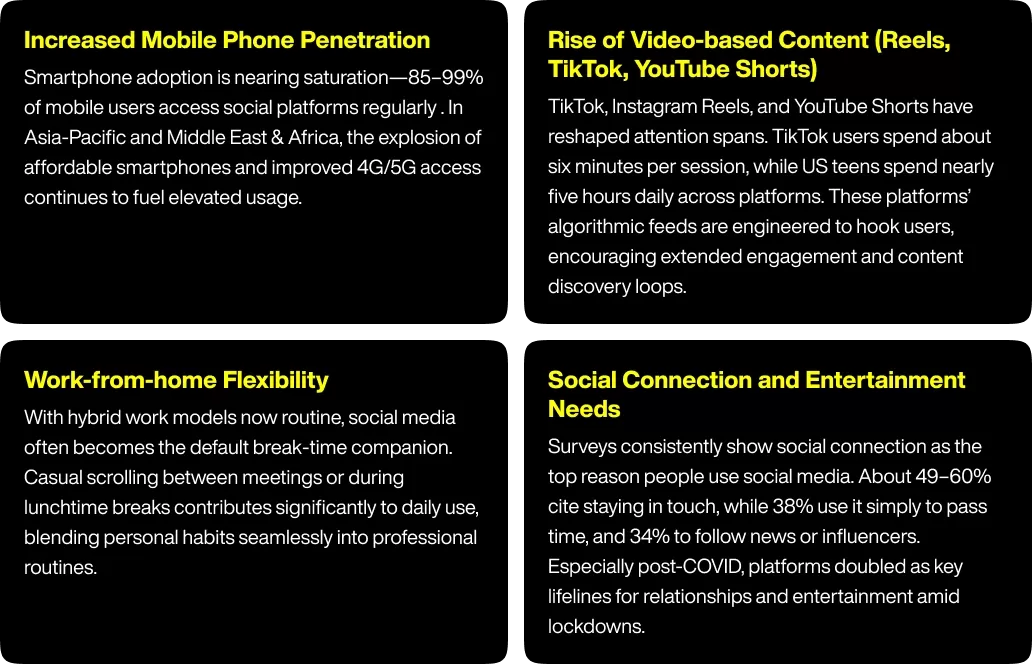
Smartphone adoption is nearing saturation — 85–99% of mobile users access social platforms regularly. In Asia-Pacific and Middle East & Africa, the explosion of affordable smartphones and improved 4G/5G access continues to fuel elevated usage.
Rise of Video-based Content (Reels, TikTok, YouTube Shorts)
TikTok, Instagram Reels, and YouTube Shorts have reshaped attention spans. TikTok users spend about six minutes per session, while US teens spend nearly five hours daily across platforms. These platforms’ algorithmic feeds are engineered to hook users, encouraging extended engagement and content discovery loops.
Work-from-home Flexibility
With hybrid work models now routine, social media often becomes the default break-time companion. Casual scrolling between meetings or during lunchtime breaks contributes significantly to daily use, blending personal habits seamlessly into professional routines.
Social Connection and Entertainment Needs
Surveys consistently show social connection as the top reason people use social media. About 49–60% cite staying in touch, while 38% use it simply to pass time, and 34% to follow news or influencers. Especially post-COVID, platforms doubled as key lifelines for relationships and entertainment amid lockdowns.
Impact of AI and Algorithmic Feeds on Screen Time
Artificial intelligence has changed the way people consume social media by making content recommendations more personalized than ever before. Instead of relying only on accounts users follow, platforms now use algorithms to predict what people are most likely to watch, like, or share. TikTok’s For You page is one of the best examples, continuously serving videos based on viewing habits and interactions. Instagram uses a similar approach through its Explore page and Reels recommendations, while YouTube suggests videos based on watch history and viewing patterns.
More recently, AI-powered features such as Meta AI and Snapchat My AI have introduced conversational experiences that encourage users to spend additional time within the apps. Combined with endless scrolling and highly personalized recommendations, these systems reduce natural stopping points and keep users engaged for longer sessions. While this improves content discovery, it has also contributed to increasing daily screen time across different age groups.
Social Media and Workplace Productivity
Social media has become a regular part of the modern workplace, particularly with the growth of remorse and hybrid working. Many employees check social platforms during short breaks, while others use messaging applications to communicate with colleagues or clients. Although brief browsing sessions may provide a mental break, excessive personal use during work hours can reduce productivity. Studies suggest that employees may spend up to 40 or 45 minutes each day on non-work-related social media, making it harder to maintain focus on important tasks.
At the same time, social media also offers practical benefits when used appropriately. Platforms such as LinkedIn support professional networking and learning, while messaging apps help teams share updates quickly. For this reason, many organizations now introduce clear social media policies rather than banning these platforms altogether. These guidelines encourage responsible use during working hours, helping employees balance personal browsing with their professional responsibilities while maintaining productivity.
Mental Health Effects of Spending Too Much Time On Social Media
While social media can offer community, creativity, and joy, its overuse presents significant mental health risks. Studies consistently link excessive social media use with increased anxiety, depression, sleep disruption, and low self-esteem, particularly among teens and young adults.
Neurological studies show that platforms are designed to affect the brain’s reward systems through dopamine-triggering interactions like likes, shares, and endless scrolling. Over time, this leads to reduced attention spans, impulsivity, and digital dependency. The “TikTok brain” concept—coined by pediatric experts—underlines cognitive fatigue and mood instability resulting from prolonged video consumption.
Moreover, curated content can lead to unhealthy social comparison, FOMO, and cyberbullying, intensifying emotional distress. In some countries, like Australia, governments have already proposed or enacted laws to ban social media access for children under 16, citing mental health data.

Harmful by Quantity & Quality
Excessive usage is undeniably linked to negative outcomes. Studies show teens logging 3+ hours daily report lower life satisfaction and increased anxiety and depression. The impact is widely recognized: in Australia, interestingly, teens using social media 1–3 hours daily fare better mentally than both low and high users.
Curated feeds and passive consumption exacerbate stress and self-comparison. Research from UBC suggests that how we engage, more than how long, drives mental health outcomes, with reflective and mindful scrolling and interactions significantly mitigating negative effects.
More Alarming Trends
Evidence suggests problematic use among adolescents correlates strongly with risks like self-harm, eating disorders, attention deficits, and bullying. Such findings have prompted legislative and industry responses, including bans on under-16 use in Australia and proposed “Kids Off Social Media Act” protections in the U.S.
A Shift Toward Digital Wellness
Fortunately, there’s rising awareness among younger generations. Over 86% of Gen Z report reducing use, and 67% acknowledge negative mental impacts, with 26% attempting a digital detox. The platforms, as such, are also moving toward more mindful design, emphasizing active interaction over passive consumption.
Tips for Managing Social Media Time
There are ways to manage social media time better and more mindfully. Here are some of these:
Clarify Your Intent
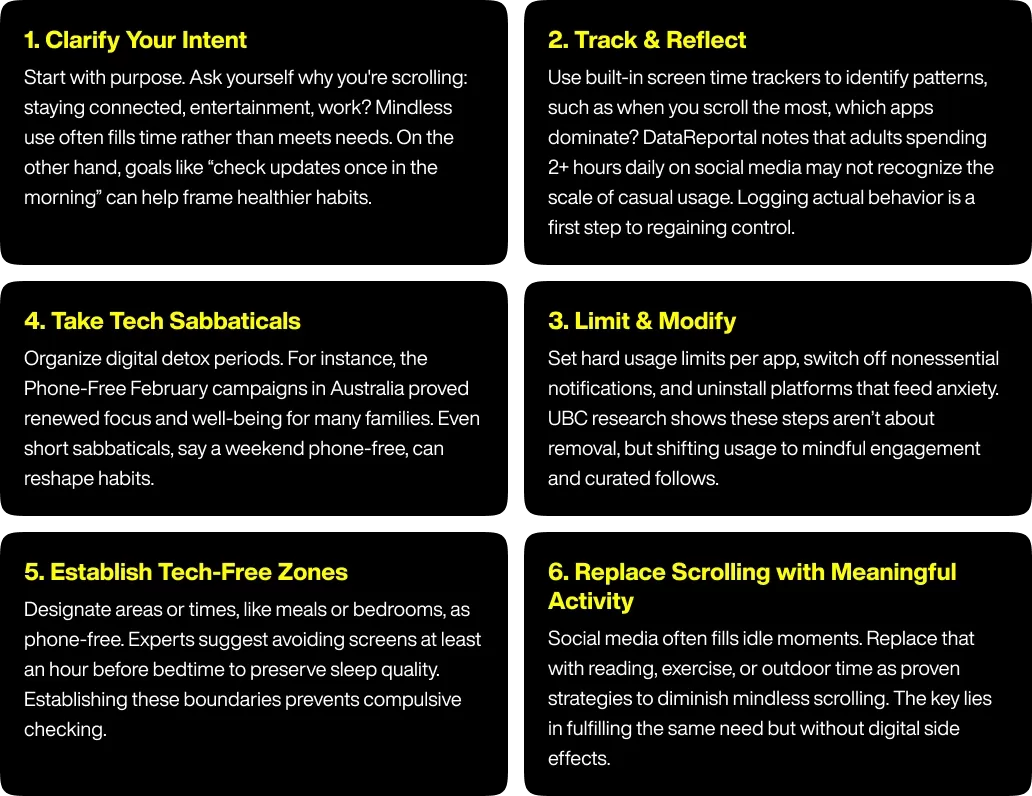
Start with purpose. Ask yourself why you’re scrolling: staying connected, entertainment, work? Mindless use often fills time rather than meets needs. On the other hand, goals like “check updates once in the morning” can help frame healthier habits.
Track & Reflect
Use built-in screen time trackers to identify patterns, such as when you scroll the most, which apps dominate. DataReportal notes that adults spending 2+ hours daily on social media may not recognize the scale of casual usage. Logging actual behavior is a first step to regaining control.
Limit & Modify
Set hard usage limits per app, switch off nonessential notifications, and uninstall platforms that feed anxiety. UBC research shows these steps aren’t about removal, but shifting usage to mindful engagement and curated follows.
Take Tech Sabbaticals
Organize digital detox periods. For instance, the Phone-Free February campaign in Australia proved renewed focus and well-being for many families. Even short sabbaticals, say a weekend phone-free, can reshape habits.
Establish Tech-Free Zones
Designate areas or times, like meals or bedrooms, as phone-free. Experts suggest avoiding screens at least an hour before bedtime to preserve sleep quality. Establishing these boundaries prevents compulsive checking.
Replace Scrolling with Meaningful Activity
Social media often fills idle moments. Replace that with reading, exercise, or outdoor time as proven strategies to diminish mindless scrolling. The key lies in fulfilling the same need but without digital side effects.
Parental Controls and Digital Literacy Education
As social media use continues to grow among children and teenagers, parental controls and digital literacy have become equally important. While parental controls help manage screen time and restrict access to unsuitable content, digital literacy teaches young users how to make safer and more responsible decisions online. Together, they encourage healthier digital habits instead of simply limiting device use.
- Apple’s screen time feature on iOS allows parents to set app limits, schedule downtime and restrict access to age-inappropriate content.
- Android devices offer similar features through Digital Wellbeing and Google Family Link, making it easier to monitor app usage and set daily time limits.
- Social media platforms have also introduced their own family safety features. Instagram Family Center gives parents greater visibility into teen account settings, while TikTok Family Pairing lets families manage screen time, privacy settings, and direct messaging controls.
- Schools also play an important role by including digital literacy programs that teach students how to identify misinformation, recognize online risks and interact responsibly on social media.
Conclusion
To sum things up, in 2026, social media remains central to global life, with users averaging between 2 hours 21 minutes and 2 hours 24 minutes daily, and Gen Z teenagers consuming up to 5 hours daily. Regional usage peaks in the Philippines and Latin America, while Asia-Pacific, North America, and Europe hover near the global average. Video-based platforms like TikTok and YouTube continue to dominate user attention.
But the conversation has shifted, and well beyond “likes” and “views.” Mental health effects and addiction risks are center stage. When used mindfully, reflectively, purposefully, and in moderation, social media can enrich connection, information access, and entertainment. It can impair well-being when it becomes reflexive or passive, especially among teens.
Individuals can tip the balance toward healthier digital lives by setting clear intentions, taking control of notifications, defining tech-free zones, and adopting mindful engagement strategies. The emerging culture of sober usage, wellness sabbaticals, and informed policy debates reflects this collective shift.
Frequently Asked Questions
What is the average time people spend on social media each day?
Globally, approximately 2 hours 21 minutes per day, with a slight dip from 2024’s 143 minutes.
Which social media platform has the highest daily usage?
TikTok leads at around 54–59 minutes/day, followed closely by YouTube (49–60 minutes/day). Facebook and Instagram average 32 minutes, with X and Snapchat around 30–34 minutes.
Do teenagers spend more time on social media than adults?
Yes. Gen Z users average 3 hours 18 minutes, while U.S. teens (13–19) often spend 4 hours 48 minutes daily, versus 18–24-year-olds at 3 hours, and older adults well under 2 hours.
Does the time spent on social media vary by country?
Greatly. Users in the Philippines, Nigeria, and Brazil spend 3.5–4+ hours/day, whereas in Japan and Germany it’s under 1 hour 40 minutes, and the U.S. sits around 2 hours 16 minutes.
How can I reduce my time spent on social media?
Define usage goals, track patterns, mute notifications, uninstall distracting apps, enforce tech-free zones and sabbaticals, and replace scrolling with meaningful offline activities.
Why is social media time increasing each year?
Factors include widespread smartphone use, hybrid work-life integration, gritty engagement via video content, curated algorithmic experiences, and human needs for connection and leisure.