

Most advertising campaigns don’t fail because businesses spend too little. They fail because marketers can’t confidently answer a simple question: Is this campaign actually making money? That’s exactly what return on ad spend (ROAS) is designed to measure. It tells you whether your advertising budget is generating revenue or quietly draining resources. ROAS has become one of the most closely watched metrics in paid advertising because it moves the conversation beyond clicks, impressions, and traffic. Those metrics may indicate activity, but they don’t always reflect business outcomes. A campaign that brings in thousands of visitors isn’t necessarily successful if it isn’t bringing in revenue. Understanding what ROAS is, how to properly calculate it, and interpret the results allows businesses to make smarter budgeting decisions, optimize campaigns with confidence, and focus on advertising that contributes to growth, not vanity metrics.
What is ROAS?
Return on ad spend (ROAS) is a metric that measures how much revenue is generated for every dollar spent on advertising. To put it simply, it answers this question:
“For every $1 invested in advertising, how much revenue did the campaign generate?”
Unlike broader business metrics, ROAS isolates advertising performance. That makes it particularly valuable for businesses running campaigns across Google Ads, Meta, LinkedIn, Microsoft Ads or other paid channels.
For example:
Advertising spend: $2,000
Revenue generated: $10,000
Your ROAS would be:
10,000/2,000 = 5
This means your advertising generated $5 in revenue for every $1 spent.
That single number immediately provides more commercial insight than metrics like impressions or click-through rates alone.
Why ROAS Matters More Than Many Marketing Metrics

Marketing teams often monitor dozens of KPIs simultaneously.
- Clicks.
- Conversions.
- CTR.
- CPC.
- Cost per acquisition.
- Engagement.
Each has its place.
Yet none directly answers whether advertising is producing meaningful revenue.
ROAS does. It ties advertising spend to business performance. A campaign that drives less traffic but a much higher ROAS may warrant more budget than one that generates impressive click numbers with poor commercial results. That distinction prevents businesses from scaling campaigns that look successful on dashboards but contribute very little to profitability. Companies that consistently make data-driven marketing choices outpace competitors in growth and efficiency. Measuring advertising by commercial outcomes, rather than surface-level engagement, is a big part of that shift.
Experienced marketers swear by ROAS for a couple of reasons. For one, it forces disciplined budget allocation. Instead of spreading spend evenly across every campaign, they can identify where additional investment is likely to yield the strongest return. This is particularly important when budgets are tight or demand fluctuates throughout the year. A campaign that consistently brings in revenue at a healthy ROAS warrants a closer look before new initiatives get funded. Conversely, campaigns with weak returns aren’t necessarily failures; they may just need better audience targeting, stronger creative, or a more relevant landing page.
ROAS vs ROI: Understanding the Difference
One of the most common misconceptions is treating ROAS vs ROI as though they are interchangeable. They are related, but they answer different business questions.
ROAS measures how effectively advertising spend generates revenue.
ROI (Return on Investment) measures overall business profitability after accounting for every associated cost. For example, imagine an advertising campaign generates:
Revenue: $20,000
Advertising spend: $4,000
ROAS equals 5:1.
At first glance, that appears excellent.
However, once manufacturing costs, salaries, software subscriptions, shipping, and overheads are included, the overall business profit could be much lower. That’s where ROI becomes valuable. Think of it this way:
- ROAS evaluates advertising efficiency.
- ROI evaluates business profitability.
Both matter. Neither replaces the other.
Marketing teams typically optimize ROAS, while finance teams often prioritize ROI when assessing overall business performance.
The ROAS Formula Explained
The ROAS formula is refreshingly simple.
ROAS = Revenue Generated from Advertising / Advertising Spend
Suppose an ecommerce business spends $8,000 running Google Ads. Those campaigns generate $40,000 in attributable revenue. The calculation becomes:
40,000 / 8,000= 5
ROAS= 5:1
Expressed another way, every advertising dollar generated five dollars in revenue. Some businesses also display ROAS as a percentage. A ROAS of 5 becomes 500%, though ratios tend to be easier for marketers to compare across campaigns. The calculation itself isn’t difficult. The challenge lies in accurately measuring both revenue and advertising costs.
How to Calculate ROAS Correctly

Learning how to calculate ROAS involves more than applying the formula. Accurate calculations depend on reliable tracking.
Step 1: Calculate Total Advertising Costs
Many businesses underestimate advertising costs by counting only media spend. A more realistic calculation includes:
- Platform spend
- Agency fees
- Creative production
- Landing page costs
- Tracking software
- Freelancers
- Campaign management
Leaving out these expenses can inflate ROAS and produce misleading conclusions.
Step 2: Track Revenue Properly
Revenue attribution matters. Use conversion tracking within advertising platforms alongside analytics software to identify purchases generated by each campaign. Without accurate attribution, ROAS quickly becomes unreliable.
Step 3: Apply the Formula
Once both numbers are verified:
Revenue/ Advertising cost = ROAS
Reliable data makes all the difference.
What Is a Good ROAS Benchmark?
One question marketers hear repeatedly is:
“What counts as a successful ROAS?” And the honest answer is: it depends. Profit margins differ enormously between industries. A SaaS company with high recurring revenue may remain profitable at a lower ROAS than an ecommerce retailer operating with thin product margins. Many advertisers reference 4:1 as a useful starting point. That means every advertising dollar generates four dollars in revenue. For many businesses, that’s considered a healthy performance level. Others require significantly higher returns. Luxury retailers, specialist manufacturers, subscription businesses, and enterprise software providers. Each has different acquisition costs and lifetime customer values. Rather than chasing someone else’s benchmark, establish your own good ROAS benchmark using:
- Gross margins
- Customer lifetime value
- Acquisition costs
- Average order value
- Sales cycle length
The goal isn’t achieving an arbitrary number.
It is achieving profitable growth.
Factors That Influence Return on Ad Spend
ROAS isn’t determined by budget alone. Two businesses can spend the same amount on advertising and see completely different outcomes because dozens of variables affect campaign performance. Understanding these variables makes it easier to identify where improvements can have the biggest impact.
Audience Targeting
Even exceptional ad creatives will struggle if it’s shown to the wrong audience. The strongest-performing campaigns are built around clearly defined customer segments based on demographics, interests, buying behavior, and search intent. As targeting becomes more relevant, wasted spend decreases, and conversions become more consistent.
Remarketing audiences and customer match lists can often produce stronger ROAS than broad targeting because they focus on people who have already interacted with your business.
Keyword Selection
Successful search campaigns are based on keywords that are highly relevant to what potential customers are searching for. Broad and highly competitive terms can generate lots of traffic, but the purchase intent of that traffic will be lower. Conversely, more specific keywords will generate fewer visitors, but often deliver better commercial results, as users are closer to making a buying decision. Regular keyword audits help to eliminate unnecessary spend, while helping to identify new growth opportunities.
Ad Creative and Messaging
People decide within seconds whether an ad is worth their attention. Strong headlines, relevant messaging, and clear calls to action all have an impact on campaign performance. Small improvements in creative can have a significant effect on click-through rates and conversion rates, which ultimately impacts ROAS. Testing different headlines, images, and offers should be an ongoing, not a one-off exercise.
Landing Page Experience
An advertisement only gets someone to your website. The landing page determines whether they convert. A disconnect between the promise made in the advertisement and the content visitors see after clicking often results in abandoned sessions and wasted advertising spend.
Fast loading times, clear messaging, straightforward navigation, and visible calls to action all contribute to stronger conversion rates.
Bidding Strategy
Modern advertising platforms offer several automated bidding options designed to maximize different outcomes. Choosing the wrong strategy can limit campaign performance even when everything else is working well. Businesses should select bidding strategies that align with campaign objectives rather than relying on platform defaults.
ROAS in Google Ads: Why It Plays Such an Important Role

When marketers discuss ROAS in Google Ads, they’re referring to one of the platform’s most valuable optimization metrics. Unlike traffic-focused campaigns, revenue-focused Google Ads campaigns use conversion data to help advertisers identify which keywords, audiences, and ads are producing the strongest financial return. Google Ads allows advertisers to monitor ROAS at multiple levels, including:
- Individual keywords
- Ad groups
- Campaigns
- Devices
- Audience segments
- Geographic locations
This level of reporting makes it easier to identify where advertising budgets should increase and where spend should be reduced. For ecommerce businesses with reliable conversion tracking, ROAS often becomes one of the primary metrics guiding campaign optimization.
Understanding Target ROAS Strategy
One of Google’s automated bidding options is the Target ROAS strategy. Rather than manually adjusting bids, advertisers tell Google the average return they want to achieve, and the platform automatically adjusts bids to maximize revenue while working towards that goal.
For example, if your target ROAS is 500%, Google’s bidding system aims to generate approximately $5 in revenue for every $1 spent. This approach works best when campaigns already have sufficient conversion history. Without enough data, automated bidding has limited information to learn from, which can affect performance. Businesses considering a target ROAS strategy should ensure:
- Conversion tracking is accurate.
- Revenue values are correctly assigned.
- Campaigns have enough historical conversion data.
- Goals are realistic rather than overly ambitious.
Setting an unrealistically high target may actually reduce traffic because Google’s system becomes more selective about when to enter auctions.
Common Mistakes Businesses Make When Measuring ROAS
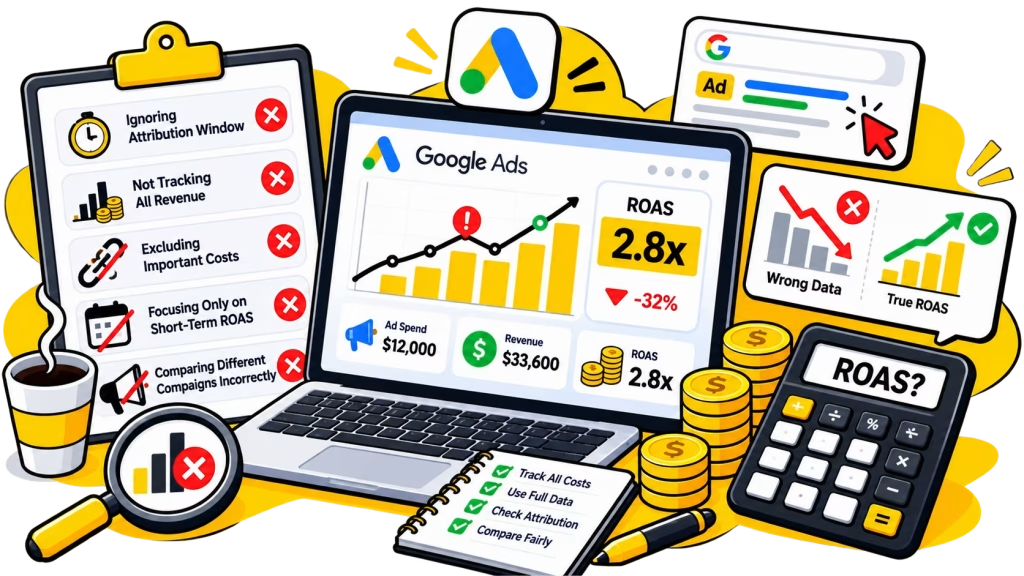
ROAS calculations are straightforward, but interpretation often isn’t. Some of the most common mistakes include:
- Ignoring agency fees, creative production costs, or software expenses when calculating advertising spend.
- Measuring revenue instead of profit for low-margin products.
- Focusing only on short-term conversions while overlooking delayed purchases.
- Comparing ROAS across campaigns with completely different objectives.
- Scaling campaigns purely because they have a high ROAS without considering overall revenue potential.
For example, a campaign generating a ROAS of 8:1 on a small budget may contribute less total revenue than another campaign producing a ROAS of 4:1 at significantly greater scale.
The best decisions come from looking beyond individual numbers and understanding the broader commercial context.
Supporting Metrics That Give ROAS More Context
ROAS is one of the most valuable advertising metrics available, but it shouldn’t be analyzed in isolation. Supporting performance indicators help explain why a campaign is succeeding or falling short. For example, a campaign with a low ROAS may not necessarily have poor targeting. It could be attracting qualified traffic, but the landing page may not be converting visitors effectively. Likewise, a campaign with a high click-through rate may still struggle if those clicks aren’t turning into customers. That is why experienced advertisers regularly review metrics such as cost per click, click-through rate, conversion rate, and average order value alongside ROAS.
A CPC calculator can help determine whether rising advertising costs are affecting campaign profitability. In contrast, a CTR calculator provides insight into how effectively your ads capture attention in search results or social feeds. Used together, these metrics help identify where optimization efforts will have the greatest impact. Rather than chasing a single number, successful advertisers build a complete picture of campaign performance before making budget decisions.
Making ROAS Part of Your Long-Term Strategy
Many businesses only review ROAS after a campaign ends. That is a missed opportunity. ROAS is far more valuable when it’s used as an ongoing decision-making tool rather than a reporting metric. Regular reviews also help identify trends before they become costly. Is one audience segment consistently outperforming another? Budgets can be reallocated. Is a particular landing page consistently underperforming? Enhancements can be prioritized before increasing ad spend. This principle applies to larger marketing operations. Agencies managing campaigns for multiple clients often use structured reporting frameworks to benchmark performance across industries and pinpoint opportunities for improvement. Companies expanding their capabilities through digital marketing outsourcing or partnering with providers offering white label SEO often rely on ROAS reporting to maintain consistent performance standards across accounts. Historical campaign data is equally valuable. Looking back at previous case studies can reveal patterns that aren’t obvious from a single reporting period, such as seasonal buying behavior, audience shifts, or creative formats that repeatedly deliver stronger returns. ROAS shouldn’t simply tell you how yesterday’s campaigns performed. It should influence where tomorrow’s advertising budget goes.
Final Thoughts
Understanding ROAS is only the starting point. The value is in the use of it to make smarter advertising decisions. A healthy return on ad spend isn’t about pouring more and more money into your budget or chasing higher traffic numbers. It’s understanding your audience, measuring performance accurately, continuously refining campaigns, and spending more in the channels that are delivering profitable growth consistently. The advertisers that consistently outperform their competitors aren’t always the ones spending the most money. More often than not, they’re the ones measuring what matters, and taking action on the insights their data provides. When viewed in conjunction with supporting metrics and a clear understanding of your business goals, ROAS is so much more than a reporting figure. It’s a practical framework for deciding where to spend, where to optimize, and where to scale.